
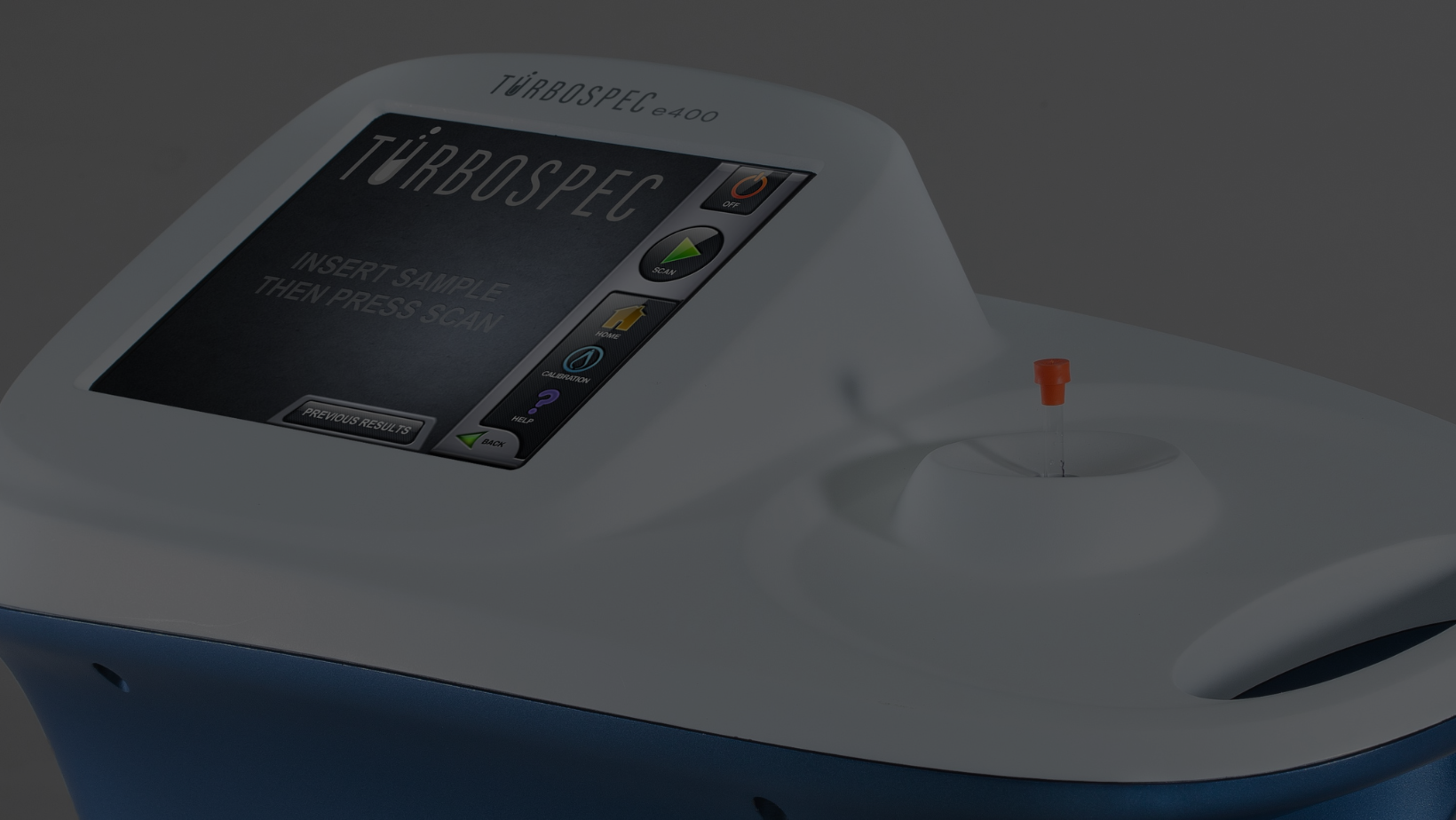
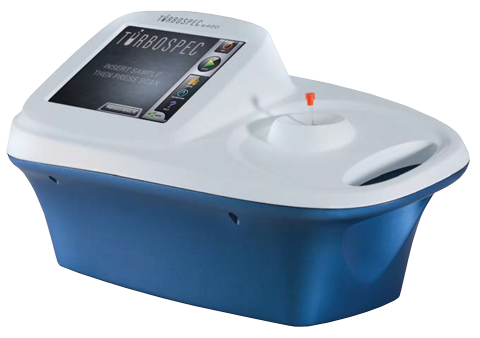
The Turbospec e400 is Turbospec’s launching product. The elemental analyzer has incorporated remarkable operational and performance features that are highly valuable for users across a wide range of industries. This product embodies the mission of the company by offering operational simplicity with unprecedented performance and quick results. Read our Frequently Asked Questions below.
What elements are analyzed by the Turbospec e400?
There is a long list of NMR-active elements that may be measured by the Turbospec e400. Turbospec has created a list of high-precision elements of interest, principally driven by demand in mining and food applications.
Here are the most commonly offered elements:
- Sodium
- Lithium
- Boron
- Phosphorous
- Proton
- Fluorine
- Chlorine.
Please inquire about the different elements required by specific applications.
How are the samples prepared?
Liquid samples are measured as-is.
Filtration is necessary only to remove solid particles.
If you start with a solid sample, read the explanation below.
How does the measurement work?
The Turbospec e400 measures the number of atoms per unit of volume in a solution by measuring the amplitude of Nuclear Magnetic Resonance signals.
As the instrument uses radio waves to inspect the sample, the measurement is not affected by the transparency or cleanliness of the solution – in contrast to optical techniques such as IR.
How does Turbospec e400 compare to titration?
The Turbospec e400 has several advantages over titration methods:
- No consumables.
- The sample is measured as is.
- There is very minimal training required.
- High accuracy due to no sample preparation errors.
How does Turbospec e400 compare to Atomic Absorption and ICP?
The Turbospec e400 costs significantly less than ICP and most high-end AA units. Maintenance and calibration are remarkably simple.
The list of elements to be analyzed by Turbospec e400 is shorter than the ICP list. Therefore, Turbospec shows value when immediate accurate results are necessary for the list of elements offered for the analysis, mainly Sodium, Lithium, Chlorine, and Boron.
ICP and AA require solutions clear of unwanted elements and significant sample dilution. These are non-issues for the Turbospec e400. This simplifies the laboratory operation and reduces sources of systematic errors.
Does the interference between elements affect the readings?
Not at all. Because the measurement is based on the response of the atoms excited during the NMR scan, other elements in the sample do not alter the readings.
NMR selectively excites the nuclear spin of selected atoms. Only in samples with organic solvents or large amounts of minerals, there may be a slight effect due to the significant alteration of the solution.
Can solid samples be analyzed?
Yes, solid samples can be analyzed, but only after the element of interest is in a solution. For example, to measure the sodium concentration in potato chips, the sample is crushed, water is added and the measurement is done in the liquid portion of the sample.
For rock samples, methods such as microwave digestion need to be used to have the mineral samples turned into a solution.
Turbospec has experience in a number of applications and will provide guidance when the samples are not in liquid form.
Does the sample need to be filtered?
No. Only large solid material from the sample needs to be removed.
For example, to measure the concentration of sodium in soup, liquid may be pipetted directly from the liquid stock and placed into the measurement tube.
For analysis of minerals, solid materials need to be removed from the solution.
What is the precision of the instrument?
The precision depends on the specific element. For example, for Lithium, Sodium, and Boron, the precision is 20 to 30 ppm (parts per million in relative weight) or 1.5%, whichever is largest.
For example, in a brine sample with 1,000 ppm of Lithium, the precision is 30 ppm. For a brine sample with 6,000 ppm of Lithium, the precision is 90 ppm or 1.5%.
Better precision is achievable with custom programming. Please consult with Turbospec personnel.
What is the LOD and LOQ?
The Limit of Detection (LOD) is approximately 3 times the standard deviation of the measurement. The Limit of Quantification (LOQ) is 10 times the standard deviation of the measurement.
The LOD for elements such as Lithium and Boron is approximately 100 ppm. Custom programming is offered for applications requiring lower LOD.
How much sample needs to be pipetted into the glass tube?
400 uL. The 5 mm diameter glass tube needs to be filled to more than 40 mm and less than 80 mm in height.
How many calibration points are necessary?
One. A single reference sample is used for calibration.
For high-accuracy measurements, it is recommended to calibrate using a standard with similar concentration levels as the one in the sample. Typically, within a factor of 3 above the concentration of interest.
For example, to measure the concentration of Boron in a brine sample with around 1,000 ppm, use a reference sample with a precise and known amount of Boron in the 1,000 to 3,000 ppm range.
Can more than one element be analyzed in one instrument?
Yes. Turbospec includes up to three elements per instrument.
The most common required elements are Sodium, Lithium, and Boron.
Does the sample need to be diluted?
No. Measure the liquid sample as is.
What standard samples should be used?
The standard samples may be a solution with accurate and known concentration or may be purchased from a chemical company or prepared by the client.
How does the Turbospec e400 compare with traditional analyzers?
The main advantages of the Turbospec e400 over conventional analytical instruments is that the sample is measured as is and the calibration and measurement are remarkably simple.
This means that there are no systematic errors associated with dilution and filtration steps.
NMR offers a more direct measurement of the concentration of elements in solution.
A direct comparison with other techniques needs to take into consideration the errors associated with sample preparation, in particular dilution.
The Turbospec e400 is less prone to operator errors due to the simplicity of the protocols.
Can the instrument be rented or only purchased?
The Turbospec e400 can be purchased or rented. The rental terms use a simple rent-to-own process. The minimal rental term is three months.
What consumables are used?
No consumables are needed to operate the Turbospec e400. Glass tubes may be reused. Some clients choose to buy a stock of glass tubes so they don’t need to clean used tubes.
Is a Turbospec technician needed for installation?
No. The instrument is plug and play. The simple installation safety considerations and protocols are presented in the User Guide.
What is the size of the sample container?
5 mm diameter NMR glass tubes. 4” length is recommended. 7” long tubes may also be used.
What is the size and weight of the instrument?
Size: 48 cm width, 25 cm height, 25 cm depth
Weight: 8.3 Kg
What is the process to obtain a quotation?
Request a quotation from sales@turbospecllc.com. Indicate the application, elements of interest, and typical concentrations to be measured.
How is the instrument packaged for shipping domestically and internationally?
The Turbospec e400 is shipped inside a custom-hardened case with laser-cut foam. The case has wheels.
For domestic deliveries, the instrument is shipped in the case.
For international deliveries, the case is placed inside a custom wooden crate – certified for freight.
Where can the analyzer be used?
For precision readings, it is recommended to use the Turbospec e400 indoors.
The instrument may be used outdoors or inside a vehicle (request custom cable).
Avoid extended sun exposure and ingress of liquid or dust from the rear vents.
What are the power requirements?
Power: input 10 to 28 V DC at 5 A. 110-240 V AC transformer and power cord included.
What is the best way to attain support?
Simply send a message with your support needs to info@turbospecllc.com.
Where are the results recorded?
Selecting the PREVIOUS RESULTS tab at the bottom of the screen displays the stored list of previous results.
The display shows the date and time of the measurement, the type of entry (measurement result or calibration), the value, and any user-entered notes. Up/Down finger swipes will scroll the display.
Custom notes may be added to the readings: After a measurement, the user can add a notation in the results file by selecting the ADD NOTES tab at the bottom of the screen.
The note may be up to 30 characters long. Notes can only be added for a measurement immediately after that measurement is made.
Can the results be downloaded?
Yes. Once a USB drive is plugged in any of the three USB outlets, a “SAVE TO FLASH” message appears in the Previous Results window. Press the bottom. Data is saved in a format that can be opened as a text file or in Excel.
How is the analyzer operated?
Inserting a Sample:
Slide the 5 mm tube down until it reaches the stop.
Calibrating:
- Select a calibration reference and insert it into the analyzer.
- Press the CALIBRATION button on the right of the display.
- Use the numerical keyboard that appears on the screen to enter the concentration value you associate with this calibration standard. Molarity is the recommended unit to be used for calibration. You may use other units of concentration, e.g. mg/ml or ppm.
- Press OK to begin the calibration. When the calibration process complete, the display will indicate that it is ready for measurements.
Measuring Concentration:
Insert the sample tube into the sample holder and press the SCAN button. The element concentration value will be displayed as soon as the scan is complete. The units are the same ones used during calibration. Correct for density if you use ppm.
What are the units of concentration?
Common solute concentration units used for elemental analysis are Molarity and parts per million. Molarity is the preferred unit to be used in the Turbospec e400, as the analyzer measures the number of atoms per unit volume.
Molarity (M) = number of moles of solute/liter of solution
The Molarity is proportional to the number of atoms per unit of volume.
Other commonly used units are parts per million:
Parts per million (ppm) = (mass of solute/mass of solution) x 106
As the concentration in ppm is the number of grams of solute per gram of solution times 106, a density correction is necessary when converting units from ppm to M. This correction is not needed for dilute solutions but is relevant when the density of the solution differs significantly from 1 gr/mL.
To convert from concentration in ppm (C[ppm]) to Molarity (C[M]) use the following formula:
C[ppm] = C[M] x (atomic weight/density of solvent) x 1000
For example, in an 8 M solution of LiCl with a density of 1.15 gr/mL, the Lithium concentration in ppm is:
C[ppm] = 8 M x (6.941 gr/M /1.15 gr/mL) x 1000 = 48,285 (mg of Lithium per kg of solvent).
What are the specifications of the analyzer?
- Size: 48 cm width, 25 cm height, 25 cm depth
- Weight: 8.3 Kg
- Power: input 10 to 28 V DC at 5 A. 110-240 V AC transformer and power cord included
- Temperature of Operation: 10 C – 50 C
- Exchangeable fuse
- RFB Radio-Frequency Controller: single channel broadband ADC reprogrammable system
- Connectivity: USB and Ethernet
- Magnet: ultra-compact high homogeneity permanent magnet with passive shielding for stray fields
- Touch screen configuration
- Touch Screen: 8″ TFT Full VGA high-brightness LCD
- Cooling: fan in back panel
- User Interface: Graphical User Interface with intuitive operation
- Sample Vial: glass test tube, 5 mm outside diameter, 100 mm length or longer
What is the process to buy a Turbospec e400 unit outside of the USA?
Secure your order by placing the Purchase Order and paying the deposit. Confirm the lead time from Turbospec’s Sales Team. Coordinate the shipment with your preferred freight company.
The customer is responsible for the payment of taxes and shipping arrangements, including customs duties. If you need support with the shipment, Turbospec will provide expert help and all the necessary documentation.